Employment Law Blog
Up to date insights on employment law and news at the Lamberton Law Firm
When Restructuring is a Lie - Discrimination in Job Eliminations
August 20, 2026
Unmasking Workplace Discrimination Behind Eliminated Positions
Former President of the Western Pennsylvania Employment Lawyers Association and Chairman of the Labor and Employment Section of the Allegheny County Bar Association | Super Lawyers (2006, 2010, 2020–2026) | Fellow of The Wendell G. Freeland Society
In over 25 years of litigating employment discrimination and wrongful termination cases across Western Pennsylvania, I have seen corporate terminology evolve. Where employers once used blatant, overt language when firing employees, today’s corporate HR departments prefer clinical, sanitizing jargon.
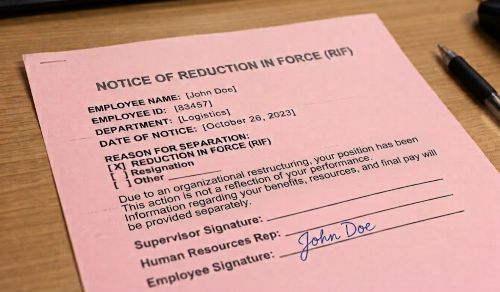
The most common phrase used to obscure illegal discrimination is "position elimination" driven by a "corporate restructuring" or "reduction in force" (RIF).
On paper, a restructuring sounds like a neutral, unassailable business decision. Executives frequently assume that if human resources labels their termination a "job elimination," they have no legal recourse.
That assumption is wrong.
Under federal anti-discrimination statutes—including the Age Discrimination in Employment Act (ADEA), Title VII, the Americans with Disabilities Act (ADA)—and the Pennsylvania Human Relations Act (PHRA), a job elimination is legally invalid if the title vanished while the work remained. In many cases, "restructuring" is simply pretext: a manufactured legal cover story designed to replace an older, highly compensated, disabled, or outspoken employee with someone younger, less expensive, or more subservient.
The Mechanics of Pretext in Corporate RIFs
To understand how discrimination operates under the guise of corporate reorganization, one must understand how courts analyze wrongful termination claims. Under the Supreme Court's long-standing McDonnell Douglas burden-shifting framework, once an employee establishes a basic (prima facie) case of discrimination, the employer must produce a legitimate, non-discriminatory reason for the termination.
A corporate reorganization or economic downsizing is the ultimate boilerplate defense. It shifts the legal burden back to the employee to prove that the company’s stated business reason was a "pretext" - in plain English, a lie designed to conceal unlawful bias.
How do we prove a restructuring was pretextual? By proving that the position was not actually eliminated at all; only the human being holding it was discarded.
Four Signs Your "Eliminated" Position Still Exists
If you have been informed that your role was eliminated due to corporate restructuring, examine the reality of your former department against these four common indicators of pretext:
1. The "New" Job Posting Mirroring Your Old Duties - A company cannot fire a 58-year-old Director of Logistics claiming the role was eliminated, only to post a listing two weeks later for a "Manager of Supply Chain Operations" that carries 80% to 90% of the exact same day-to-day responsibilities. Renaming a job title, tweaking a salary band, or adjusting minor reporting lines does not constitute a true position elimination under the law. If the core functional duties survive and are assigned to a newly hired worker outside your protected class, the restructuring defense begins to crumble.
2. Complete Absorption by a Younger or Non-Protected Colleague - In a genuine reduction in force, duties are typically fragmented and distributed broadly across an entire remaining team to absorb excess workload, or discontinued entirely. However, if 100% of your critical job functions were quietly handed off to a single, substantially younger or less-experienced colleague who was retained, courts in the Third Circuit routinely view this as evidence that the company merely swapped employees under the guise of an organizational chart update.
3. Papering the File Right Before the Announcement - Often, a corporate "restructuring" is hastily invented to bypass an employee who has an exemplary performance history. If you received stellar annual reviews for five straight years, but suddenly received your first negative performance memo 30 days after disclosing a medical disability, requesting FMLA leave, or turning 60, the timing is deeply suspicious. Employers frequently attempt to "paper" an employee's personnel file immediately prior to a RIF so they can argue you were selected based on relative performance rather than protected status.
4. Inconsistent Explanations from Management - When an employer lies, the story rarely stays consistent across time. During internal termination meetings, HR might tell you the separation is "purely financial and not performance-related." Yet, when responding to an Equal Employment Opportunity Commission (EEOC) charge or the Pennsylvania Human Relations Commission (PHRC), the company’s defense lawyers might argue you were chosen for the RIF due to "subpar leadership metrics." These shifting, contradictory justifications are classic markers of pretext that trial lawyers use to destroy the employer's creedibility.
How We Uncover the Truth in Litigation
Exposing a fraudulent restructuring requires aggressive discovery. Having handled complex employment trials and recovered millions of dollars for executives, managers, and professionals throughout Pittsburgh and Allegheny County, we approach these cases by pulling back the curtain on internal communications. We target:
- Organizational Charts: We request all iterations of department org charts created in the six to twelve months leading up to the termination. These files often reveal that your name was marked for removal long before any economic audit took place.
- Internal Email & Slack Records: Human resources and C-suite executives frequently leave digital footprints. Internal messages discussing an employee's age ("needs fresh energy"), medical leave ("can't rely on their schedule"), or salary ("too expensive for the long haul") undermine claims of a neutral restructuring.
- Comparative RIF Selection Data: Under the Older Workers Benefit Protection Act (OWBPA), if an employer terminates two or more employees in a group layoff, they are legally required to disclose the job titles and ages of everyone selected and not selected for the RIF. Statistical disparities in these disclosures frequently prove that older workers were targeted at disproportionate rates.
If your employer notifies you that your job has been eliminated as part of a restructuring:
- Do Not Sign a Severance Agreement Until You Speak with an Employment Lawyer: Employers routinely attempt to pressure departing professionals into signing release-of-claims agreements within days. If you are 40 or older, you are legally entitled to up to 21 or 45 days to review the severance agreement.
- Preserve Key Evidence: Secure copies of your historic performance evaluations, written commendations, job descriptions, organizational charts, and any emails referencing your work duties or RIF discussions (ensuring you adhere to confidentiality obligations).
- Document the Timeline: Write a comprehensive, dated personal chronology of all relevant events leading up to the termination notice while your memory is fresh.
If you are an executive, manager, or professional in Western Pennsylvania facing a suspicious job elimination or severance offer, contact Lamberton Law Firm at (412) 258-2250 or cal@lambertonlaw.com to schedule a confidential case evaluation.